Food Isn’t Just About Weight. It’s About How You Function.
- mastoic
- Jul 8
- 3 min read
The conversation about food in popular culture has been narrowed down to one thing:
How your body looks.
Calories in, calories out. Foods that are allowed and foods that are forbidden. The body as a project to be managed rather than a system to be supported.
It is a framework that dominates gyms, social media, and most diet books.
And it misses most of what food actually does.
What food is really doing
Body composition can matter.
It would be dishonest to pretend otherwise.
But reducing the entire conversation about food to its effect on weight means ignoring most of the picture.
Food influences energy stability across the day. It affects whether you move through your hours with a reasonably consistent supply of focus and capacity, or whether you experience repeated crashes and recoveries that drain far more than the missing energy itself.
It influences mood in ways that are increasingly well documented and still underappreciated in daily life.
It shapes sleep quality in ways that then affect everything else.
Two meals with similar calorie counts can create entirely different experiences in the hours that follow.
One may leave you clear, steady, satisfied, and capable.
Another may leave you sluggish, searching for stimulation within an hour, mentally foggy, and experiencing a low-level discomfort you cannot quite name.
That difference, repeated meal after meal across weeks, months, and years, accumulates into something significant.
Understanding food as daily support rather than only as a weight-management tool changes the questions you ask and the decisions you make.
Why people struggle
The most important thing to understand about poor eating patterns is that they are almost never caused by ignorance.
Most people already know the basics.
Vegetables are better than biscuits. Consistent meals are better than skipping all day and collapsing at night. Heavily processed food eaten constantly is not doing them any favours.
The information is not the missing piece.
The problem is almost always conditions.
Fatigue makes the easiest option feel like the only viable one.
Chronic stress pushes the nervous system toward high-reward, low-effort choices as a form of self-regulation.
Convenience culture has made ultra-processed food the path of least resistance at almost every turn.
Emotional depletion leaves a person reaching for comfort rather than nourishment.
Chaotic schedules make preparation feel impossible.
All-or-nothing thinking turns one imperfect meal into the collapse of an entire plan.
A person at seven in the evening, tired from a long and stressful day, standing in a kitchen with no prepared food and minimal energy, will almost always make a different choice than the same person who is rested and prepared.
That is not a character difference.
That is a conditions difference.
This is why what is in the kitchen matters more than what is in the nutrition knowledge.
Why preparation matters more than willpower.
Why systems matter more than intentions.
The two frameworks that do not work
Most people relate to food through one of two emotional patterns.
Neither serves them well.
The first is using food for comfort and reward.
Eating to manage emotions. To numb. To soothe a nervous system running hot.
This is understandable. Food can provide short-term relief.
The problem is that it rarely addresses the underlying need, and often adds guilt on top of the original discomfort.
The second is using food for control.
Restricting as a form of self-discipline. Treating hunger as something to be defeated rather than responded to. Equating eating less with virtue and eating more with failure.
This approach tends to produce overcorrection cycles and creates a relationship with food defined by tension rather than support.
Neither framework produces a stable result because neither is based on what food actually is.
What food actually is
Support.
That is it.
Support for concentration through a long working day.
Support for the body during physical training and recovery.
Support for mood stability in difficult periods.
Support for the immune system across winter months.
Support for the energy required to parent, work, think, maintain relationships, and show up consistently in a demanding life.
When nourishment is treated as support rather than reward or punishment, the decisions around it become calmer.
There is less drama. Less negotiation. Less of the charged quality that turns every meal into a statement about character.
That shift, from food as performance to food as function, is one of the most practically useful changes a person can make.
Not a diet change.
A framework change.
And it starts with asking a different question.
Not, “Is this allowed?”
But, “Does this support me today?”
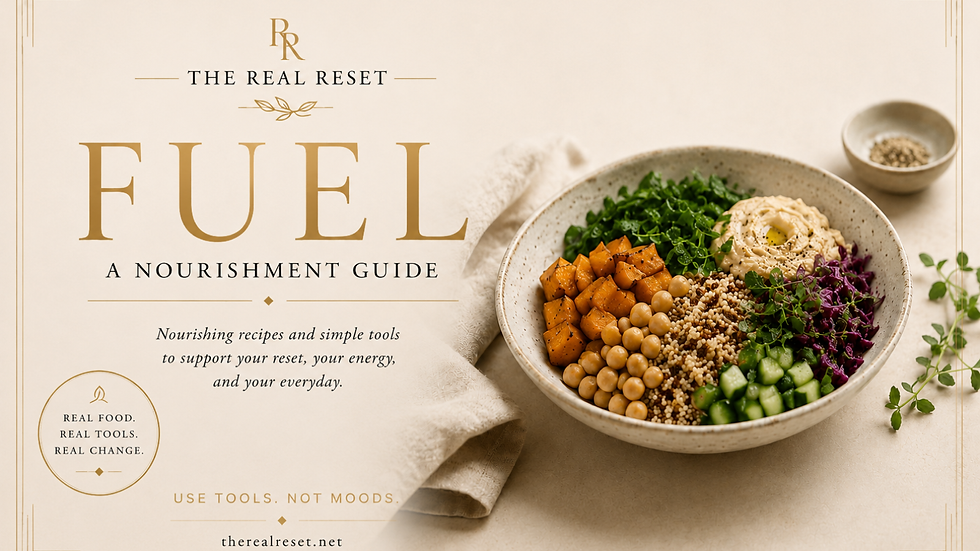
The Real Reset: FUEL is a practical food system for eating well without turning every meal into a project. Simple food. Better rhythm. Less drama around nourishment.


Comments