Stop Carrying Everything in Your Head. THE REAL RESET 30 DAY JOURNAL
- mastoic
- Jul 7
- 4 min read
Most people don't need another book about habits. They've read several. They know what to do. The problem isn't information. It's that knowing and doing are two completely different things, and the gap between them keeps growing.
What tends to close that gap isn't more advice. It's a reliable structure for paying attention to your own life, consistently, over time.
That's what a guided journal is actually for. Not self-expression. Not gratitude lists. Not manifesting. A practical place to notice what's happening, track what's working, and return to when the drift starts.
Why people keep losing the thread
Motivation behaves like weather. It arrives without warning, lifts you briefly, and disappears the moment conditions change. Most people build their systems on it anyway, which is why those systems collapse the moment life gets heavy.
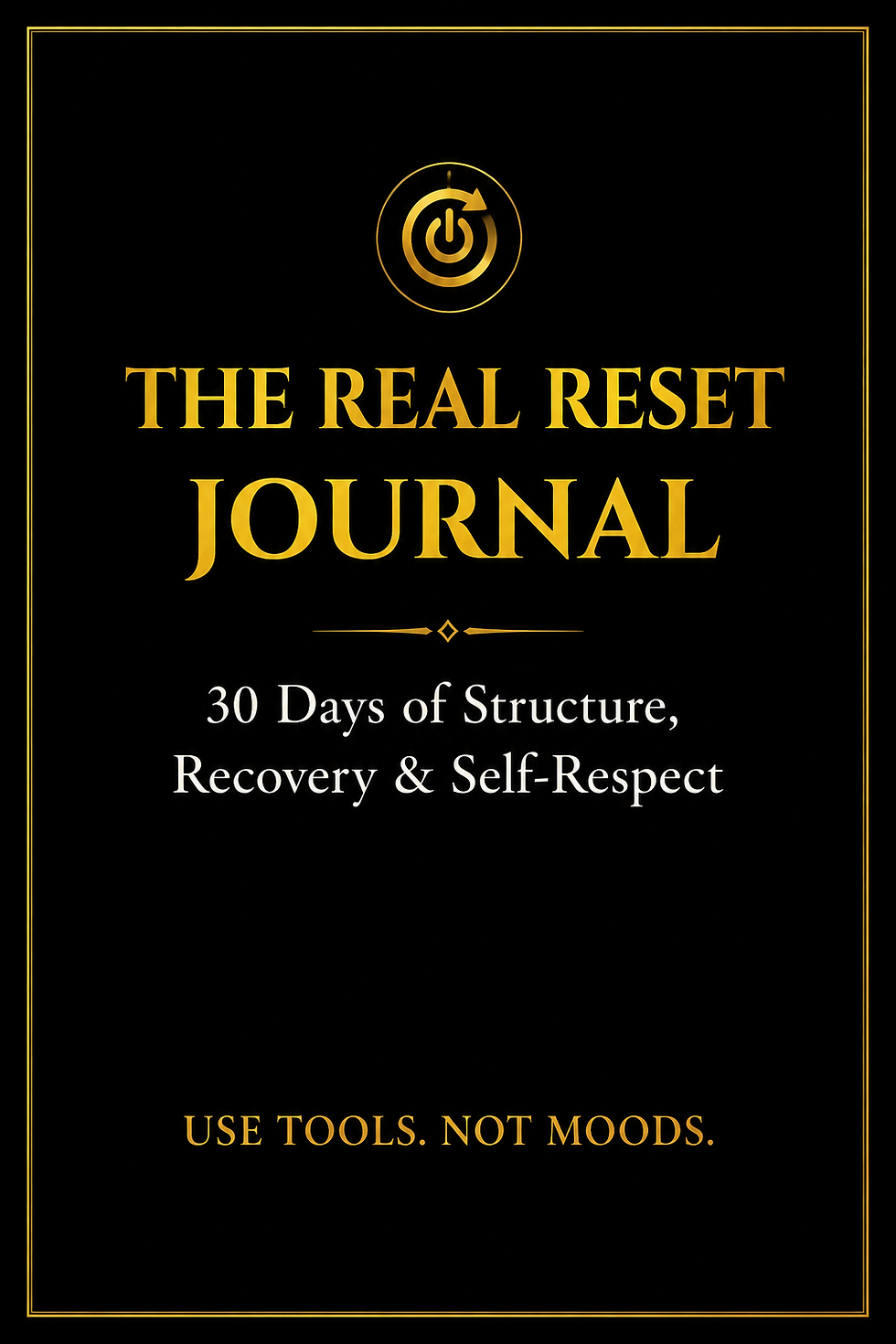
Structure is different. You build it deliberately, and then you use it regardless of how you feel. That's the whole point. The Real Reset Guided Journal is built on this distinction. It doesn't ask you to feel motivated. It gives you something to return to when you don't.
The premise is simple. Most people already know what they need to do. The problem is the absence of a reliable system for doing it when conditions aren't ideal.
What makes guided journaling different
A blank journal asks too much. You sit down, open an empty page, and the question of where to start becomes its own obstacle. Most blank journals end up with three enthusiastic days of entries followed by weeks of empty pages.
A guided journal removes that friction. The structure is already there. You just show up and use it.
The Real Reset Guided Journal runs on a 30-day cycle. Each day has one page. Three to five minutes. You record your mood state, your main reset action, what helped, what drained you, one win, one adjustment, and one action for tomorrow. Then one honest question: did you use a tool or follow a mood?
That last question is the whole system in one sentence.
What the weekly structure actually does
Each week opens with three pages: a habit tracker, a mood and energy tracker, and a planning page. At the end of the week, there's a review page. These aren't optional extras. They're where patterns become visible.
A bad Monday is just a bad Monday. Three bad Mondays in a row is a pattern worth examining. The trackers make that visible in a way that carrying it all in your head never does.
The habit tracker is a seven-day grid. You write up to six habits in the left column and mark each day honestly, done or not done. The goal isn't a full grid of ticks. The goal is an accurate one. An incomplete but honest record is more useful than a completed but fictional one.
The mood, energy, and sleep tracker works the same way. Rate mood and energy from one to five. Record hours slept. Don't try to interpret the numbers daily. Look at the pattern at the end of the week. Does mood track with sleep? Does energy consistently drop mid-week? Are there low points on the same days every week? That's the kind of information that changes things, because you can't adjust what you haven't noticed.
The reset tool built into each week
The journal includes guided reset pages throughout, signposted at the start of each week. These address specific areas: chaos audit, structure audit, energy budget, sleep design, morning design, pattern interrupts. They're not motivational exercises. They're practical assessments of what's actually happening in a specific area of your life.
Each week's planning page names the reset tool for that week. You use it when it's relevant and return to it when needed. The tools are designed to be used more than once, because the drift that happens in week two is different from the drift that happens in week eight.
The principles underneath it
Ten reset principles sit at the front of the journal. They're worth reading carefully before Day 1. A few of the most important:
You cannot think your way out of a behavioural problem. Insight is useful. It's not sufficient. Understanding why you avoid something doesn't automatically make you stop avoiding it. You act your way out. You use the tool, take the step, make the call, and clarity follows.
Track what you do, not what you intended to do. Intention tracking is not tracking. If you write down what you planned and never check whether it happened, you're building a comfortable fiction.
One rule beats ten goals. Ten goals produce anxiety, diluted focus, and the daily experience of failure across multiple fronts. One rule, clearly defined and consistently applied, produces change.
You are not starting again. Every time you return to the journal after a period of drift, you're not starting over. You're bringing more information than you had before. The drift itself is data.
What this journal doesn't do
This isn't a happiness journal. It won't ask how grateful you are. It won't tell you that you are enough. It won't ask you to manifest anything.
It won't celebrate you for showing up, because showing up is the work, not the achievement. It won't shame you for missing a day, because a missed day is data, not a verdict.
A journal completed at sixty percent across thirty days will tell you far more about your actual patterns than a perfect week followed by three blank ones. Consistency at a modest level is the goal. Not perfection.
Who this is for
People who are mentally cluttered and struggling to see their own patterns clearly. People who keep meaning to get consistent and keep losing the thread. People who want something practical to hold onto rather than another motivational read that fades within a fortnight.
It's a write-in companion for people who want to stop drifting and start noticing what's actually happening in their life. Not a journal to display. One to use.
The Real Reset Guided Journal is a practical write-in companion for building structure, noticing patterns, and rebuilding trust with yourself one honest page at a time. therealreset.net

Comments